Does AI Actually Improve Learning? What New Classroom Evidence Says
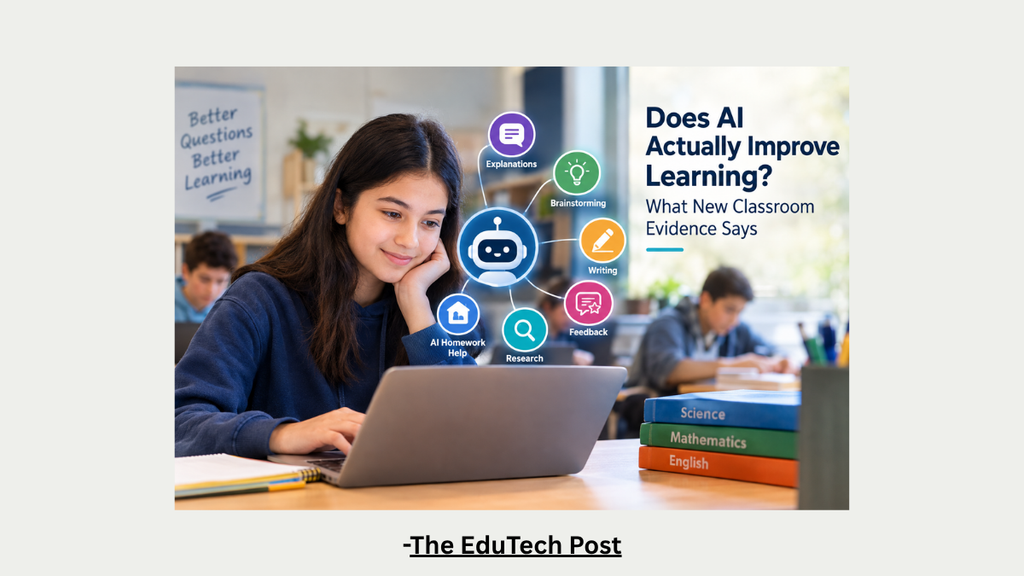
Imagine a student stuck on a difficult science question. Instead of raising a hand or searching through a textbook, they open an AI chatbot and get an explanation in seconds.
The answer is clear. The wording is polished. The student moves on.
But here is the question educators are now asking: Did the student actually learn?
That question has become much more important in 2026. Artificial intelligence is no longer an experimental technology sitting on the sidelines of education. Students are using it for explanations, brainstorming, writing, feedback, research and AI homework help, while teachers are using AI to create resources and support instruction.
Yet new evidence suggests that the answer to whether AI improves learning is not simply yes or no. AI can help students learn. But it can also make it easier for them to complete a task without developing the knowledge and thinking skills behind it. The application of AI is often what makes a difference.
AI Can Improve Learning—But Not Automatically
One of the clearest findings in the latest research is that better-looking work does not necessarily mean better learning.
The OECD’s Digital Education Outlook 2026 makes an important distinction: generative AI can improve students’ performance on tasks, but that improvement does not automatically translate into genuine learning. When students hand over too much of the thinking to a chatbot, they may produce stronger answers while putting in less of the mental effort needed to understand the subject.
Think about a student writing an essay.
If AI helps the student identify a weak argument, ask questions and suggest areas to reconsider, the student is still doing much of the intellectual work. But if AI writes the argument, finds the evidence, organizes the paragraphs and produces the final answer, the finished essay may be impressive while the student’s own learning remains limited.
That distinction could become one of the biggest issues in AI-powered education.
The Research Isn’t All Negative
It would also be misleading to say that AI does not help students.
A 2026 meta-analysis published in Humanities and Social Sciences Communications examined 35 experimental studies involving 4,193 participants. The researchers found a moderately positive overall effect of ChatGPT on student learning outcomes. However, the researchers also found that the effects varied according to factors such as subject, instructional approach and duration of the intervention.
That matters.
It suggests that the important question isn’t simply:
“Does ChatGPT work?”
A better question is:
“Under what conditions does AI help students learn?”
That is a much more useful question for schools, teachers and parents.
When AI Becomes a Learning Partner
AI appears more promising when it supports the learning process instead of replacing it.
For example, imagine a student struggling with algebra.
Instead of asking AI for the answer, the student could ask:
“Give me a hint, but don’t solve the problem.”
The AI could then ask a question that helps the student identify the next step. That is a very different experience from copying a complete solution.
The OECD’s 2026 research highlights tutoring, feedback, questioning and personalized support as promising uses of generative AI when they are guided by sound teaching principles. It also notes that AI can support critical thinking and collaboration when learning activities are deliberately designed around those goals.
In other words, AI can become less like an answer machine and more like a learning partner.
Feedback May Be One of AI’s Strongest Uses
One area where recent classroom research is particularly interesting is feedback.
A 2026 experiment involving undergraduate economics students found that students who received continuous AI-generated feedback showed greater participation and stronger improvement in content learning than students who received classroom-level lecturer feedback alone.
Another 2026 randomized study involving 144 university students examined GPT-4-generated feedback during academic writing. Students receiving individualized AI feedback produced higher-quality revisions and showed greater behavioral engagement during the revision process.
Why could this matter?
Teachers have limited time.
A teacher may know exactly what a student needs to improve but cannot always provide detailed, individual feedback every time a student writes a paragraph, solves a problem or revises an answer.
AI can potentially fill some of that gap, but the role of teacher feedback remains important when students need deeper guidance, context and human judgment.
The Biggest Risk: Students Stop Doing the Thinking
The most important warning in the current evidence may be about cognitive offloading. Learning is not simply about seeing the correct answer. It involves struggling with ideas, making mistakes, testing possibilities and eventually understanding why something works.
AI can remove much of that productive struggle. Suppose a student has difficulty understanding photosynthesis. They ask an AI chatbot for an explanation and receive a perfect, personalized response.
That sounds helpful.
But if the student never tries to explain the concept themselves, answer questions or wo rk through confusion, the technology may have made the learning process easier without necessarily making the learning deeper.
The OECD warns that excessive reliance on general-purpose GenAI can reduce the mental engagement involved in turning answers into understanding. In some circumstances, students can perform better with AI available but lose that advantage when they later have to work independently. That’s why convenience should not be confused with learning.
The concern is closely connected to the wider debate about whether AI is encouraging students to avoid doing their own academic work.
What New PISA Evidence Adds to the Debate
Fresh findings from the OECD’s PISA 2025 results make the issue even more interesting.
According to the OECD, students who reported using AI to draft text for writing assignments performed worse than students who said they did not use AI for that purpose.
However, the picture changes when students use AI as a learning aid and are taught how to evaluate AI-generated information. Among frequent AI users, those who received guidance on assessing AI-generated information tended to perform better than those who did not receive such guidance.
This is an important distinction.
The problem may not be simply AI use.It may be uncritical AI use. A student who accepts every AI response as correct is using the technology very differently from a student who checks sources, questions the answer, looks for errors and compares the response with what they already know.
AI literacy is therefore becoming more and more crucial.
What the Latest PISA Evidence Says About AI and Learning
The latest PISA findings offer a closer look at how students are using AI and what that means for learning. This OECD video explains the evidence, including the role of AI literacy, critical thinking, and the risks of relying on ready-made AI answers.
“PISA 2025: How is artificial intelligence impacting education?” — OECD
Students Need to Learn How to Question AI
In the past, digital literacy often meant knowing how to search Google, evaluate websites and protect personal information. AI adds another layer. Students must now comprehend that even if an AI system generates a convincing response, it may still be wrong.
They need to ask:
- Where did this information come from?
- Can I verify it?
- Does the explanation actually make sense?
- What evidence supports the claim?
- What might the AI have missed?
- Can I explain the answer without AI?
The OECD and European Commission’s 2026 AI Literacy Framework emphasizes the ability of students to understand AI systems, critically evaluate their outputs and use AI responsibly and creatively.
This implies that in the future, schools might have to teach something more useful than just how to use AI. Students must learn how to think while using AI.
AI Should Not Replace Productive Struggle
There is a temptation to measure educational technology by how quickly it solves a problem. But education doesn’t always work that way.
Sometimes the five minutes a student spends wrestling with a difficult problem are more valuable than the five seconds it takes AI to produce the answer.
A useful classroom approach could therefore be:
Try → Think → Ask AI → Check → Revise → Explain
The student attempts the problem first. AI can then provide a hint, another perspective, an example or feedback. The student checks the information, revises their thinking and finally explains the concept independently. That keeps the learner involved.
It also changes the role of AI from doing schoolwork for students to helping students become better at doing schoolwork themselves.
What This Means for Teachers
Teachers don’t necessarily need to choose between embracing AI and banning it. The more important challenge is designing activities in which AI has a clear educational purpose.
For example, a teacher could ask students to do the following rather than using AI to write a history essay:
- Write their own initial argument.
- Ask AI to challenge the argument.
- Identify inaccuracies or weak reasoning in the AI response.
- Check the claims against reliable sources.
- Rewrite their argument.
- Explain what they changed and why.
Now the technology becomes part of the learning activity rather than a shortcut around it. This approach also gives teachers something valuable: a way to observe how students think, rather than judging only the final product.
So, Does AI Actually Improve Learning?
The newest evidence gives us a more complicated—and more useful—answer.
Yes, AI can improve learning. But access to AI alone does not guarantee better learning.
Research in 2026 shows genuine benefits in areas such as feedback, engagement and learning outcomes. At the same time, major international evidence warns that students can become overly dependent on AI and perform tasks successfully without developing the underlying knowledge and skills. There is another issue schools cannot ignore: not every student has equal access to AI tools, reliable devices or the guidance needed to use them effectively. The difference appears to depend heavily on the learning design.
AI works differently when it:
- gives a student a complete answer instead of a useful hint;
- writes an essay instead of challenging the student’s argument;
- solves a problem instead of helping the student reason through it;
- replaces reflection instead of encouraging it;
- produces information instead of teaching students to evaluate it.
The real opportunity may therefore not be AI-powered education. It could be better-designed learning, with AI in the right place.
Final Thoughts
The educational debate over AI has progressed beyond the question of whether students should use it.
The more important question is what happens to learning when they do.
The strongest emerging evidence does not paint AI as either an educational miracle or a disaster. Instead, it points toward a middle ground: AI can provide meaningful support when it is deliberately designed around learning, but it can become counterproductive when it removes the thinking that students need to develop for themselves.
For parents and educators, that may be the most useful lesson of all.
Don’t just ask, “Did AI help the student finish the work?”
Ask:
“After using AI, can the student understand it, question it and do it independently?”
That is where the difference between using AI and learning with AI emerges.

Digital Literacy and Cybersecurity for Students

Khan Academy – Free Online Lessons and Practice Questions for K-14

Grading Reform in Schools: Why Eliminating Zeros Isn’t Enough
About Author
