What Should Students Learn About AI Before They Graduate?
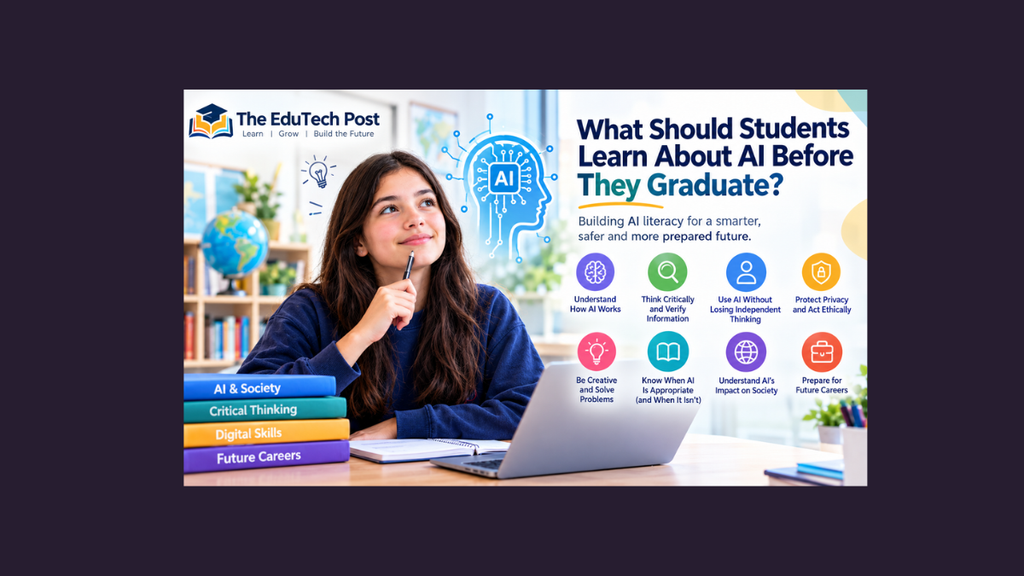
Imagine a student graduating from high school in a world where artificial intelligence can write essays, generate images, explain complex scientific concepts, and even assist with coding. The student knows how to use these tools—but can they recognize an incorrect answer, protect their personal information, or complete a task without AI?
That distinction could shape how prepared young people are for college, careers, and everyday life.
Artificial intelligence is rapidly transforming the way people learn, work, and communicate. As a result, schools face a new responsibility: preparing students not just to use AI but to understand it, question it, and make responsible decisions about when to rely on it.
This is where AI literacy for students becomes essential. The goal is not to turn every graduate into a programmer or AI expert. Instead, students need the knowledge and judgment to work with AI without surrendering their creativity, critical thinking, or independence.
In 2026, the OECD and European Commission published Empowering Learners for the Age of AI, a framework designed to help primary and secondary education systems prepare students for a world increasingly influenced by artificial intelligence. Its central message is important for schools, parents, and educators: young people need more than technical familiarity. They need the ability to engage with AI critically, creatively, and responsibly.
Therefore, what should students actually know before they graduate?
1. Understanding How Artificial Intelligence Works
Students do not need advanced mathematics or a degree in computer science to develop a basic understanding of AI. However, they should know what happens behind the screens of the tools they use every day.
For example, generative AI systems learn patterns from large amounts of data and use those patterns to generate responses. They can produce convincing explanations, images, summaries, and computer code, but their output is not automatically accurate.
This phenomenon explains why an AI chatbot might invent a reference, provide outdated information, or confidently give an incorrect answer. Students who understand these limitations are less likely to treat AI as an unquestionable authority.
Schools can introduce the fundamentals through age-appropriate activities. Younger students might explore how technology recognizes patterns, while older students could examine how training data influences AI responses or why a chatbot sometimes produces different answers to similar questions.
The objective is not to teach every student how to build an AI model. It is to help them understand the technology well enough to use it thoughtfully.
Students can also explore how AI is changing learning in our article on AI homework helpers.
2. Critical Thinking: Questioning AI Instead of Trusting Every Answer
One of the most important skills students can develop is the ability to evaluate information independently.
AI can make research faster, but speed does not guarantee reliability. A chatbot might simplify a complicated subject so much that important details disappear. It may also overlook context, repeat a misconception, or present unsupported claims as facts.
Students should learn to ask questions before accepting an AI-generated response:
- Is the information correct and up to date?
- What evidence supports the answer?
- Can I verify the claim with a reliable source?
- Are important perspectives or details missing?
- Can I express the answer in my own words?
Consider a student researching renewable energy for a science project. AI might provide a useful overview of solar and wind power, but the student should verify statistics, examine credible scientific sources, and understand the limitations of the information presented.
This approach transforms AI from a shortcut into a starting point for more profound investigation. It also prepares students for a world in which convincing misinformation can spread quickly. Whether they are researching a college assignment, reading news online, or evaluating information at work, the ability to question digital content will remain valuable.
3. Using AI Without Losing Independent Thinking
Can students become too dependent on AI? It is a question educators increasingly need to consider.
When students ask AI to solve every problem, write every paragraph, or provide every explanation, they may complete assignments without developing the underlying skills those assignments are designed to teach. The solution is not necessarily to prohibit AI. Instead, schools need to teach students how to use it without replacing their own thinking.
Consider a student struggling with algebra. Asking AI to explain a difficult concept or offer a hint may help the student move forward. Asking for the complete solution, copying it, and moving on may eliminate the opportunity to practice.
A more productive learning process would look like this:
Try independently → Ask AI for guidance → Check the explanation → Solve the problem again → Explain the reasoning.
This approach encourages students to remain active participants in their learning. The same principle applies to writing. Students can ask AI for feedback on the clarity of an argument, but they should still develop their own ideas, evaluate the suggestions, and take responsibility for the final work.
As explored in our article on whether AI actually improves learning, the real question is not simply whether students can produce better work with AI. It is whether they understand the material well enough to apply it independently.
4. Recognizing AI Bias and Checking the Evidence
AI systems learn from data, and data can contain errors, stereotypes, and gaps in representation. Consequently, an AI-generated answer may reflect bias or present an incomplete picture of a subject.
Students should learn to recognise that AI outputs are not necessarily neutral simply because they come from technology.
For example, a student researching historical figures might notice that an AI-generated summary gives extensive attention to some groups while overlooking others. Another student might compare AI-generated career recommendations and discover that the suggestions rely on assumptions about gender or background.
These situations offer opportunities to discuss fairness, representation, and the importance of evidence.
Students should also understand that different AI tools can produce different responses to the same question. Comparing those responses with trustworthy sources helps them recognise uncertainty rather than assume that one answer must be correct.
This skill is particularly valuable in research, science, journalism, healthcare-related information, and other areas where inaccurate claims can have serious consequences. The aim is not to make students suspicious of every AI response. It is to help them develop a healthy habit of verification.
5. Protecting Privacy and Using AI Ethically
AI literacy must also include digital safety.
Students sometimes share information with online tools without considering where that information goes or how it may be processed. They might upload a photograph, paste a private conversation into a chatbot, or include identifiable details in a prompt.
Before graduation, students should understand why they should never casually share passwords, sensitive personal information, confidential school records, or another person’s private details with an unapproved AI service.
They should also learn to check school policies and the privacy practices of the tools they use. For further guidance, UNESCO’s recommendations on generative AI in education explain the importance of protecting student data and using AI responsibly.
Ethical questions matter just as much as privacy. Is it acceptable to create an AI-generated image of another student without consent? Should someone share a realistic fake video of a classmate as a joke? What happens when AI-generated content damages another person’s reputation?
These examples make responsible AI use more concrete. Students should understand that being technically capable of creating something does not automatically make it ethical to do so. Consent, honesty, fairness, and accountability remain important even when AI is involved.
6. Knowing When AI Use Is Appropriate—and When It Is Not
An AI-ready graduate should understand that using AI is not appropriate for every task.
Some assignments are designed to evaluate independent writing, mathematical reasoning, language skills, or personal reflection. If AI does the work that students are supposed to practice, the assignment may no longer measure what the teacher intended.
However, other assignments may specifically encourage AI use for brainstorming, research, feedback, or creative exploration. Students must therefore comprehend the distinction between assistance and substitution.
For example, a teacher might allow students to use AI to develop essay ideas but require them to write the essay independently. Another teacher might ask students to generate an AI response, identify its errors, and improve it using evidence.
Both approaches can be educationally valuable when expectations are clear. Schools should explain their AI policies to students in a language they understand. Students should know when disclosure is required, what kinds of assistance are permitted, and how to acknowledge AI use honestly.
These habits can also prepare them for college and professional environments, where expectations around AI use may differ between courses, organizations, and roles.
7. Developing Creativity and Problem-Solving Skills
AI can generate ideas quickly, but students still need to decide which ideas are useful, original, and appropriate for a particular situation. This is where creativity becomes an important part of AI literacy.
Imagine a group of students planning a campaign to reduce food waste at school. They could use AI to brainstorm slogans, organize research questions, or explore different presentation formats.
However, the students must still investigate the actual problem, understand their audience, choose realistic solutions, and develop a message that reflects their own judgment. The technology may expand their options, but it cannot automatically replace their understanding of the people and circumstances involved.
The same principle applies to coding, design, writing, and science projects. Students should learn to direct AI toward a clear goal, compare its suggestions, improve weak ideas, and explain why they selected a particular solution. This also encourages experimentation. Students can test different approaches, learn from unsuccessful results, and refine their work instead of accepting the first output.
Ultimately, the strongest use of AI is not necessarily producing something faster. It is using technology to explore possibilities while retaining responsibility for the outcome.
8. Preparing for Careers in an AI-Influenced World
Students graduating today may enter workplaces where AI is integrated into research, communication, administration, design, and decision-making. Students can explore related career opportunities in our guide to preparing students for future jobs.
Some will pursue careers in computer science, robotics, data science, or AI development. Others may work in education, business, healthcare, engineering, finance, or creative industries.
Not every student has to become an AI specialist. However, understanding how AI can support a task—and where human judgment remains necessary—may become increasingly useful across professions.
Students should therefore develop a combination of technical awareness and transferable skills.
These include:
- Problem-solving: Identifying a problem and determining whether AI can assist.
- Communication: Explaining ideas clearly and evaluating AI-generated content.
- Adaptability: Learning new tools without depending entirely on a particular application.
- Collaboration: Working effectively with other people when technology is involved.
- Decision-making: Weighing evidence, recognizing limitations, and accepting responsibility for choices.
For example, a future marketing professional might use AI to explore customer trends but still need to understand the audience and evaluate the evidence. An engineer might use AI-assisted tools while remaining responsible for testing designs and checking safety requirements.
These examples illustrate why future readiness involves more than learning a particular tool. Students need the judgment to apply technology appropriately as tools and workplaces change.
9. Understanding AI’s Impact on Society
AI is not just a classroom technology. It can influence the information people encounter, the services they receive, and the decisions organizations make. Students should understand both its potential benefits and its possible harms.
AI can help researchers analyze large datasets, support accessibility, and assist with complex tasks. At the same time, its use can raise questions about employment, surveillance, misinformation, bias, copyright, and accountability. Schools can encourage students to explore these questions through debates, case studies, and research projects.
For instance, students might examine whether an organization should use AI to screen job applications. They could consider efficiency, privacy, potential bias, and the importance of human review.
Another class might investigate how AI-generated images affect trust in online information. These discussions help students recognize that technological progress involves choices. The impact of AI depends not only on what a system can do, but also on how people design, regulate, and use it.
Developing this understanding prepares students to participate more thoughtfully in a society where AI-related decisions are becoming increasingly common.
How Schools Can Teach AI Literacy Before Graduation
Schools do not necessarily need to introduce a separate AI subject immediately. Many essential skills can be integrated into existing lessons.
In English classes, students can evaluate AI-generated arguments and improve their own writing. In science, they can check AI explanations against scientific evidence. In computer science, they can explore algorithms and data. In social studies, they can discuss misinformation, privacy, and the social impact of automated decisions.
A gradual approach can help schools match instruction to students’ development.
Elementary school: Introduce basic concepts about AI, patterns, privacy, and responsible technology use.
Middle school: Teach students to verify information, recognize limitations, question outputs, and use AI for guided learning.
High school: Develop more advanced research, ethical reasoning, creative collaboration, transparency, and career-related AI skills.
These are suggested learning priorities rather than a universal curriculum. Schools should adapt them to local standards, students’ needs, and available resources.
Teacher preparation is equally important. Educators need practical guidance on selecting suitable tools, designing meaningful assignments, explaining AI limitations, and establishing clear expectations. Teachers can also explore the European Commission’s course on developing students’ AI literacy for practical strategies to integrate AI literacy into classroom teaching.
Without that support, students may encounter conflicting rules from one classroom to another. Consistent guidance can make responsible AI use easier to understand and practice.
What Parents Can Do to Help Children Become AI-Literate
Parents do not need advanced technical knowledge to help children develop good AI habits. They can begin with simple conversations. When a child uses a chatbot to answer a question, parents can ask, “How do you know that is correct?” or “Can you explain the answer without looking at the screen?”
Such questions encourage children to verify information and develop their own understanding.
Parents can also discuss privacy, consent, misinformation, and school rules. Younger children may need closer supervision, while teenagers can gradually take greater responsibility for evaluating tools and making informed decisions.
It is also worth discussing the difference between using AI to learn and using it to avoid learning. A tool that explains a difficult concept may be helpful; a tool that completes every assignment may prevent a child from practicing essential skills. The goal is not to treat AI as automatically good or bad. It is to help children recognize its value, limitations, and responsibilities.
The Real Meaning of Being AI-Ready
Preparing students for an AI-influenced world requires more than teaching them how to write effective prompts or use popular applications. They need to understand how AI works, question its answers, verify evidence, protect privacy, respect academic integrity, and use technology creatively without losing their ability to think independently.
The OECD and European Commission’s 2026 AI literacy framework offers schools a useful foundation for developing these capabilities. The challenge now is to translate those principles into meaningful classroom experiences.
For educators, that means creating opportunities for students to experiment with AI while also asking them to explain, question, verify, and reflect. For parents, it means encouraging curiosity without allowing technology to replace independent effort.
And for students, the most important lesson may be this: AI can assist with many tasks, but it cannot remove the need for sound judgment.
An AI-ready graduate is not simply someone who knows how to use artificial intelligence. It is someone who knows when to use it, when to question it, and when to think independently.

6 TedEd Best Motivational Videos for Kids – Health, Confidence and Success

6 Must-Have Skills for the Future Workforce

The Educational Power of Social Media
About Author
