Why Schools Are Teaching Students Quantum Computing
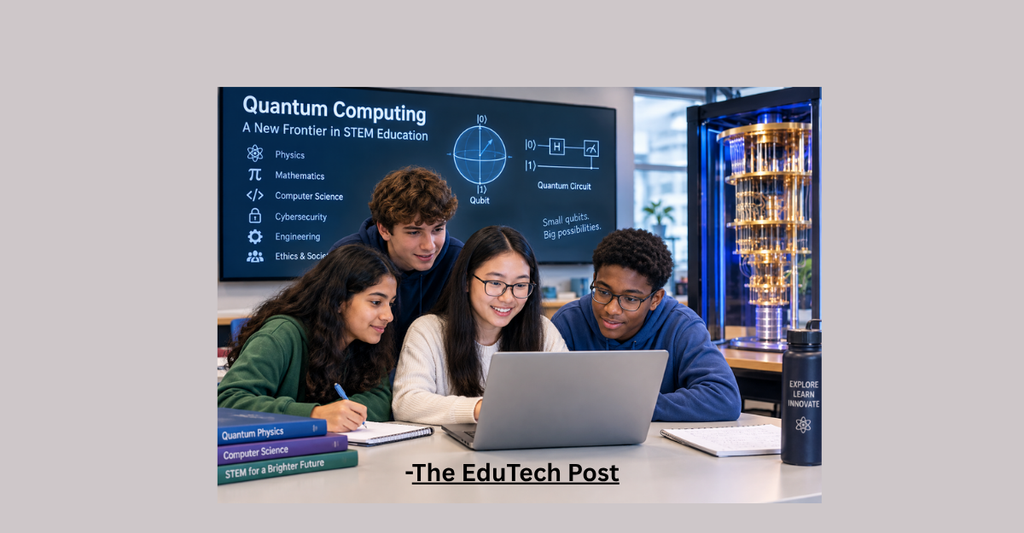
Imagine a high school student writing code that runs on an actual quantum computer—not years after graduating, but as part of a classroom or enrichment program today.
That idea may have sounded unrealistic a decade ago. It is becoming increasingly practical.
Across the U.S. and Canada, educators, universities, government initiatives, and technology organizations are beginning to introduce students to quantum science and quantum computing. The goal isn’t to turn every teenager into a quantum physicist. Instead, quantum computing in schools is emerging as a way to expose students to a rapidly developing field and connect physics, mathematics, computer science, and problem-solving.
The shift is also being supported by new educational resources. The U.S. National Q-12 Education Partnership is developing age-appropriate quantum learning materials and encouraging hands-on experiences, while Canada’s quantum ecosystem is investing in talent development and youth STEM engagement.
So why are schools starting to teach something that still sounds so advanced?
Quantum Computing Is Moving Beyond the University Lab
Quantum computing is based on principles of quantum mechanics and uses quantum systems to process information in ways fundamentally different from traditional computers.
Students don’t necessarily need to begin with complicated equations.
Modern school resources can introduce ideas such as superposition, entanglement, quantum measurement, qubits, and quantum algorithms through demonstrations, games, coding activities, and familiar STEM concepts.
The National Q-12 Education Partnership, for example, has developed frameworks showing how quantum information science can connect with existing middle-school subjects such as probability, atomic structure, light, and computational thinking.
That makes quantum education less about adding an entirely new subject and more about finding connections within subjects students already study.
Why Schools Are Paying Attention Now
One major reason is the growing demand for people who understand quantum technologies.
The U.S. National Quantum Initiative has explicitly identified K–12 education as part of the longer-term effort to build a quantum workforce. Its programs include classroom materials, teacher professional development, career awareness, internships, and summer opportunities.
Canada is taking a similar approach. Its National Quantum Strategy includes efforts to develop quantum talent and create training and work-integrated learning opportunities, while also encouraging STEM engagement among younger students.
Schools therefore have an opportunity to introduce students to the field before they reach university. That early exposure matters because students cannot pursue a field they have never encountered.
Students Can Learn Quantum Computing Without Becoming Physicists
One misconception is that quantum computing belongs exclusively to advanced physics students.
That is changing.
Stanford’s introductory high-school quantum computing course, for example, is designed for public high school students and requires no background beyond high-school algebra. Students learn about qubits and quantum gates, write quantum programs, explore real-world applications, and can work with real quantum computers through Qiskit. Students can build a stronger foundation for these skills by first developing coding and computational thinking skills, which help them understand how computer programs solve problems.
Similarly, the University of Chicago’s EPiQC program has developed a two- to three-week module for high-school computer science students. It introduces quantum concepts and quantum programming without requiring prior knowledge of quantum physics or advanced mathematics.
This approach is important. Instead of asking students to master quantum mechanics first, educators can give them an accessible entry point and gradually build their understanding.
Quantum Computing Connects Multiple STEM Subjects
Perhaps one of the most interesting reasons to introduce quantum computing in schools is that it naturally crosses subject boundaries.
A single quantum lesson can bring together:
- Physics through quantum mechanics and the behavior of light and matter
- Mathematics through probability, vectors, complex numbers, and linear algebra
- Computer science through algorithms, programming, and computational thinking
- Cybersecurity through quantum cryptography
- Engineering through hardware and system design
- Ethics and society through discussions about how emerging technologies could affect people and industries
The National Q-12 framework specifically identifies connections between quantum information science and existing physics and computer science curricula. Quantum computing is also part of a broader effort to make STEM education more engaging, as explored in our article on 6 Innovative Ways to Make STEM Classrooms More Engaging.
That interdisciplinary quality makes quantum computing particularly interesting for schools looking to strengthen STEM learning without treating every technology as a separate subject.
Students Can Experiment With Real Quantum Technology
Quantum computing also offers something that many emerging technologies struggle to provide: students can experiment with the technology remotely.
IBM’s Quantum Learning platform includes classroom modules on quantum teleportation, key distribution, Grover’s algorithm, Shor’s algorithm, and quantum Fourier transforms. Some activities allow students to experiment with real quantum systems or built-in simulators.
IBM’s 2026 Qiskit Global Summer School also offered a beginner track, coding labs, lectures, and hands-on quantum computing activities for learners around the world.
This means a school does not necessarily need its own quantum computer sitting in a laboratory. Cloud-based access and simulations can give students opportunities to experiment with quantum concepts using ordinary computers.
Canada is developing its own quantum learning pipeline.
The movement isn’t limited to the United States. Canada has developed a particularly visible ecosystem around quantum education.
The University of Waterloo’s Institute for Quantum Computing ran the 2026 Quantum School for Young Students, a free enrichment program for Canadian high-school students covering topics including quantum computing, algorithms, quantum mechanics, quantum cryptography, and quantum optics.
The university also offers Quantum for Educators, helping teachers learn how to introduce quantum concepts into existing curricula through hands-on activities and lesson plans. Meanwhile, Canadian initiatives are also expanding youth access. The University of British Columbia’s Geering Up program, for example, supports K–12 quantum computing workshops, clubs, camps, games, and curriculum resources.
The message is becoming increasingly clear: quantum education is not simply about training future researchers. It is also about giving younger students an early understanding of a technology that may influence many industries.
The Goal Is Bigger Than Creating Quantum Programmers
Schools don’t need to produce thousands of quantum programmers.
In fact, that would be too narrow a goal. Quantum technologies could eventually intersect with fields such as medicine, materials science, cybersecurity, finance, chemistry, logistics, and communications. Students who understand the basic ideas may eventually apply that knowledge in completely different careers.
That’s why early quantum education can be viewed as technology literacy, rather than simply career training. Introducing students to emerging technologies can also help them think more broadly about preparing students for future jobs and the skills tomorrow’s careers may require.
A student might never build a quantum algorithm professionally. But understanding what quantum computing can—and cannot—do could become useful when that student encounters quantum technology later as a scientist, engineer, entrepreneur, policymaker, or technology professional.
What Quantum Lessons Could Look Like in a School
Quantum computing does not have to begin with a difficult lecture. A classroom lesson could begin with a simple probability activity, then use polarized light to demonstrate concepts related to quantum behavior, introduce the concept of a qubit, and allow students to construct a basic quantum circuit.
More advanced students could use Qiskit to experiment with quantum algorithms. This hands-on approach is already appearing in education programs. Stanford’s high-school course, for example, combines foundational concepts with programming and real-world applications.
The University of Chicago’s classroom module similarly uses quantum circuits and Qiskit to connect computer science knowledge with quantum concepts.
The result is a learning experience that can feel less like memorizing another scientific theory and more like exploring an emerging technology.
Teachers Will Be Just as Important as the Technology
Introducing quantum computing into schools also raises an obvious question: Who will teach it?
Most K–12 teachers were not trained as quantum computing specialists. That is why teacher preparation is becoming an important part of the movement.
The U.S. National Quantum Initiative lists professional development for teachers among its K–12 workforce activities.
Canada’s Quantum for Educators program takes a similar approach by giving teachers hands-on activities, lesson resources, and guidance on bringing quantum topics into existing courses.
This matters because technology alone doesn’t create meaningful learning. A well-prepared teacher can help students move beyond the excitement of hearing about “quantum computers” and actually understand the scientific and computational ideas behind them.
There Are Still Challenges
The expansion of quantum education does not mean every school is ready to add a quantum computing course. There are practical challenges.
Teachers need appropriate training. Students need suitable mathematical and computing foundations. Schools need access to reliable digital tools. Curriculum time is already limited, and quantum concepts can be intimidating when introduced without the right context.
There is also a risk of turning quantum computing into another technology buzzword. The solution is not necessarily to teach more advanced material. It is to teach the correct concepts at the appropriate age.
The National Q-12 Education Partnership itself describes K–12 quantum education as an emerging area and is developing frameworks and resources that can evolve as the field develops. That gradual approach may be more realistic than trying to transform quantum computing into a standard subject overnight.
What Students Could Gain From Learning Quantum Computing
The most valuable outcome may not be the ability to write quantum code.
Students can also develop thinking habits that can be applied to other STEM disciplines. Quantum education can encourage students to:
- Think probabilistically rather than only in binary terms
- Understand that complex problems can require new computational approaches
- Connect abstract scientific ideas with real technology
- Explore interdisciplinary problems
- Experiment, test, and revise their ideas
- Consider the societal implications of emerging technologies
These skills can remain valuable even as quantum hardware and software continue to evolve.
The Bigger Shift in STEM Education
Schools have spent years introducing students to coding, robotics, artificial intelligence, cybersecurity, and data science.
Quantum computing represents another step in that evolution. But the important question isn’t whether every student needs to become a quantum expert. It is whether students should have the opportunity to understand the technologies that could shape the world they enter.
Current programs in the U.S. and Canada suggest that educators are beginning to answer that question with greater interest. From high-school courses and summer programs to teacher workshops and cloud-based quantum laboratories, students are getting more opportunities to explore the field before university.
Final Thoughts
Quantum computing may still be an emerging technology, but quantum education is already moving into classrooms and student programs.
The most promising approach isn’t to overwhelm students with advanced mathematics or complicated physics. It is to make the concepts accessible, connect them with existing STEM subjects, and give students opportunities to experiment.
For schools, this could mean more than just teaching another new technology. It could mean helping students become comfortable learning about technologies that do not yet have all the answers. And in a rapidly changing technological world, that may be one of the most valuable skills education can provide.

The Educational Power of Social Media

What’re Coursera’s Online Courses About

Multilingual Digital Education: Expanding Access Beyond English
About Author
